
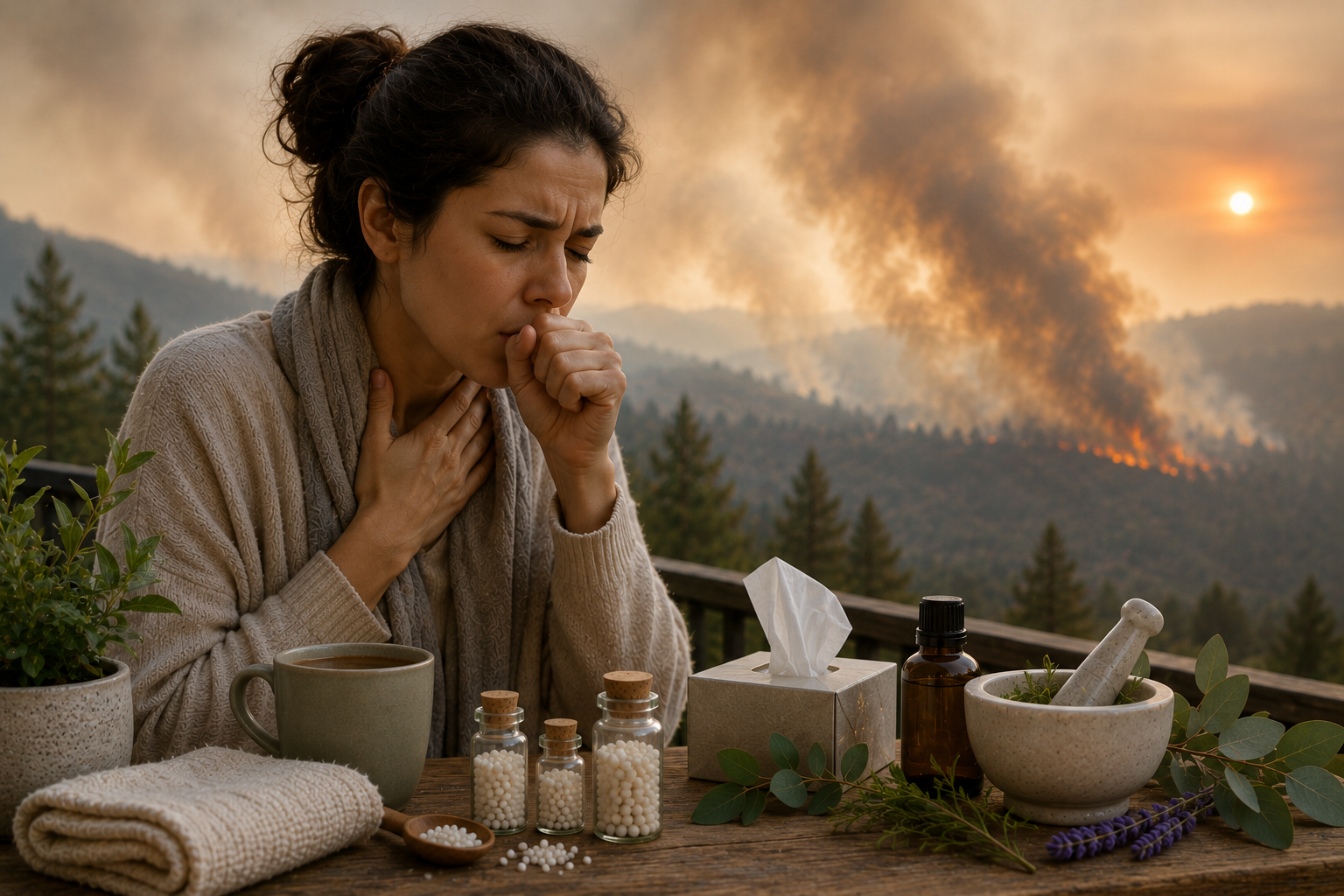
Wildfires can be frightening even when the flames are many miles away. The sky turns orange or gray. The air smells of burning wood. Ash settles on cars and windowsills. You may wake with a scratchy throat, burning eyes, a headache, or a cough that seems to come from deep in the chest.
For people living in wildfire-prone areas such as California, wildfire smoke is becoming a recurring seasonal concern. And smoke exposure does not necessarily end when the visible smoke disappears. Some people recover quickly. Others continue to experience:
- A dry, irritating cough
- Burning or scratchy throat
- Tightness or discomfort in the chest
- Wheezing
- Shortness of breath
- Sinus irritation and congestion
- Burning or watery eyes
- Headaches
- Fatigue
- Increased sensitivity to odors or air pollution
Wildfire smoke is a complex mixture of gases and fine particles produced by burning vegetation, buildings, and other materials. These fine particles can irritate the eyes and respiratory tract and may aggravate existing heart and lung conditions. This is where many people begin asking: “What can I do to support my body after breathing wildfire smoke?” For some individuals, individualized homeopathic care may be considered as complementary support during recovery.
First: Smoke Inhalation Can Be Serious
Before discussing homeopathy, it is important to distinguish between mild irritation from smoke exposure and a potentially serious inhalation injury. Seek urgent medical care for symptoms such as:
- Significant difficulty breathing
- Severe or worsening shortness of breath
- Chest pain
- Confusion or unusual drowsiness
- Blue or gray lips
- Severe wheezing
- Coughing up blood
- Symptoms following direct exposure to a structure fire or intense smoke
- Any rapidly worsening respiratory symptoms
People with asthma, COPD, heart disease, or other chronic respiratory conditions may be particularly vulnerable to wildfire smoke. Children, older adults, and pregnant individuals may also require additional precautions. Homeopathy should never delay emergency evaluation or replace prescribed treatment.
The Most Important “Treatment” Is Reducing Further Exposure
The first step is not a remedy. It is reducing the amount of smoke you continue to breathe. During periods of unhealthy air quality, public health authorities recommend checking local air quality, limiting outdoor exposure, keeping windows and doors closed when appropriate, and using appropriate respiratory protection if going outside is necessary. A properly fitting NIOSH-approved N95 respirator can help reduce exposure to fine particles when outdoor exposure cannot be avoided.
You can also consider: Creating a cleaner indoor-air space
- Keep windows and doors closed during heavy smoke conditions.
- Use appropriate air filtration.
- Avoid adding indoor pollutants such as candles, fireplaces, or tobacco smoke.
- Consider using a portable air cleaner.
- Follow local evacuation orders immediately.
The EPA also provides guidance on creating cleaner indoor spaces and reducing exposure to wildfire smoke and ash. No homeopathic remedy can make it safe to continue breathing heavily polluted air. The exposure must be addressed first.
How Can Homeopathy Help After Wildfire Smoke Exposure?
In classical homeopathy, the goal is not to prescribe a generic “smoke inhalation remedy.” Homeopathy does not work on the principle of: “One exposure = one remedy.” Instead, the remedy is selected according to the individual pattern of symptoms.
Two people may breathe the same wildfire smoke but develop completely different reactions. One may have a dry, hacking cough. Another may have a burning sensation in the chest. A third may develop thick mucus and sinus congestion. Someone else may feel exhausted, anxious, restless, and unable to sleep after the experience. The totality matters. The homeopath considers:
- What symptoms appeared first?
- What is the quality of the cough?
- Is the cough dry or productive?
- Is there burning or rawness?
- Is the chest tight?
- Is breathing worse from exertion?
- Is there wheezing?
- Is the throat dry or full of mucus?
- What makes the symptoms better or worse?
- How did the person respond emotionally to the wildfire experience?
- Was there fear, shock, panic, helplessness, or prolonged stress?
The remedy is chosen based on the individual response of the person, not simply the name of the exposure. If you are experiencing persistent, non-emergency symptoms after wildfire smoke exposure, learn more about individualized homeopathic support.
Common Symptom Patterns Considered in Homeopathic Case Analysis
The following remedy pictures may sometimes be considered by a classical homeopath when they correspond to the person’s complete symptom picture. These are not recommendations for self-prescribing and are not a substitute for medical assessment.
1. Aconitum
Aconitum may come into consideration when an acute illness follows a sudden, frightening experience. The person may be:
- Highly anxious
- Restless
- Frightened about their health
- Suddenly unwell after an exposure
- Experiencing acute respiratory symptoms
The emotional reaction may be particularly prominent. A wildfire can be a deeply frightening experience, especially when someone is evacuating, uncertain about the safety of their home, or worried about family members and pets. In a suitable case, the suddenness and intensity of the reaction may be important.
2. Arsenicum album
Arsenicum album may be considered when there is a combination of:
- Respiratory irritation
- Anxiety
- Restlessness
- Burning sensations
- A need for reassurance
- Fear about health or safety
The person may feel worse when alone and may repeatedly seek reassurance. The mental and physical symptoms can be closely connected. A person may say: “I know the smoke is gone, but I still feel like something is terribly wrong.” The specific symptom pattern and modalities would determine whether this remedy is appropriate.
3. Spongia tosta
Spongia may be considered in certain cases of a dry, harsh, barking or sawing cough. The cough may be:
- Dry
- Irritating
- Persistent
- Worse at certain times of day or night
The sound and quality of the cough are important. A classical homeopath would not prescribe Spongia simply because a person has a cough after wildfire smoke exposure. The complete picture must correspond.
4. Phosphorus
Phosphorus may enter the differential when there is marked respiratory sensitivity, a tendency toward irritation, and heightened sensitivity to environmental influences. The person may be sensitive to:
- Smoke
- Odors
- Air pollution
- Cold air
- Environmental changes
The cough and chest symptoms must be studied in detail. The person’s general constitution and characteristic symptoms are essential to the prescription.
5. Bryonia
Bryonia may be considered when a dry, painful cough is aggravated by movement. The person may prefer to remain still because movement aggravates the discomfort. There may be dryness and irritation of the respiratory passages. Again, the remedy is not selected simply because the patient has “smoke cough.” The modalities and totality are what matter.
6. Ipecacuanha
Ipecacuanha may be considered in certain cases where respiratory symptoms are accompanied by:
- Persistent coughing
- Difficulty clearing the chest
- A sensation of mucus
- Nausea associated with the cough
The cough may be particularly spasmodic or distressing. The precise pattern determines whether this remedy is appropriate.
7. Nux vomica
Nux vomica may be considered in some cases involving marked irritation and sensitivity after environmental exposure. The person may be:
- Oversensitive to smells
- Irritable
- Tense
- Unable to relax
- Experiencing respiratory irritation
However, the remedy picture must be individualized. The fact that someone has been exposed to smoke is not, by itself, enough to indicate Nux vomica.
The Emotional Impact of Wildfires Should Not Be Ignored
Wildfires affect more than the lungs. They can affect the nervous system and emotional health. People may experience:
- Fear of losing their home
- Anxiety about evacuation
- Sleep disruption
- Hypervigilance
- Repeatedly checking air quality or fire maps
- Distress about animals or family members
- Grief after property loss
- Ongoing anxiety every time they smell smoke
For some people, the emotional reaction continues long after the immediate danger has passed. A person may say: “Every time I smell smoke now, I panic.” Or: “I can’t sleep because I’m afraid the fire will come back.”
In classical homeopathy, the mental and emotional response is not separated from the physical symptoms. The way a person experiences an event may provide important information about their individual susceptibility and remedy picture.
What About a Lingering Cough After the Smoke Clears?
One of the most common reasons people seek complementary support is a cough that persists after the air quality improves. The cough may be:
- Dry or productive
- Irritating or spasmodic
- Worse at night
- Worse with talking
- Worse with cold air
- Worse when lying down
- Associated with chest tightness
- Accompanied by sinus drainage or throat irritation
These differences matter. In classical homeopathy, “cough after wildfire smoke” is not a complete case. The homeopath needs to understand the individual pattern. For example: “I have a cough.” is very different from: “I have a dry, tickling cough that starts as soon as I lie down and is worse from talking, with a raw sensation behind the breastbone.” The second description provides much more information for individualization. Not sure whether your symptoms are part of a lingering smoke response? Schedule an individualized consultation.
Can Homeopathy Help Prevent Smoke Damage?
This is an important question. Homeopathy should not be used as a substitute for reducing smoke exposure. A remedy cannot:
- Filter wildfire smoke from the air
- Replace an N95 respirator
- Replace air filtration
- Make prolonged exposure safe
- Replace emergency medical treatment
- Reverse serious smoke inhalation injury
The best protection is to reduce exposure and follow reliable public health guidance. Homeopathic care may be considered as complementary support for an individual’s symptoms and recovery when appropriate.
When Might You Consider a Homeopathic Consultation?
You may wish to consider an individualized consultation if:
- You continue to experience respiratory irritation after smoke exposure.
- You develop a persistent cough or throat irritation.
- You feel unusually sensitive to smoke or environmental odors.
- Your symptoms are lingering or recurring.
- You feel physically depleted after the wildfire event.
- The emotional impact of the wildfire continues to affect your sleep or daily life.
- You want individualized complementary support alongside appropriate conventional medical care.
A consultation is particularly valuable when the symptoms are complex, changeable, or do not fit a simple pattern.
Homeopathy Looks at the Person—Not Just the Exposure
A wildfire is the event. But the person is the case. One individual may develop a dry, barking cough. Another may experience burning in the chest. Another may develop thick mucus. Someone else may experience persistent fear and anxiety. And another may feel exhausted for weeks after the event. Classical homeopathy asks: What is unique about this person’s response? That individual response is the foundation of the homeopathic case.
At Natural Bridges Homeopathy, I take an individualized approach to understanding the physical, emotional, and constitutional patterns that may arise after stressful environmental exposures.
If you are experiencing persistent symptoms after wildfire smoke exposure, the first step is always appropriate medical evaluation when needed. For ongoing, non-emergency symptoms, individualized homeopathic care may provide complementary support as you work toward recovery. You do not have to ignore lingering symptoms simply because the fire is no longer visible.
Frequently Asked Questions
Can homeopathy help with wildfire smoke exposure?
Homeopathy should not replace emergency care or measures that reduce exposure to wildfire smoke. For lingering, non-emergency symptoms after exposure, individualized homeopathic care may be considered as complementary support based on the person’s specific symptom pattern.
What symptoms can occur after wildfire smoke exposure?
Wildfire smoke may cause symptoms such as coughing, throat irritation, eye irritation, headaches, chest discomfort, and respiratory irritation. People with asthma, chronic lung disease, heart disease, and other conditions may be more vulnerable to smoke exposure.
Is homeopathy safe for smoke inhalation?
Serious smoke inhalation can be a medical emergency and requires prompt medical evaluation. Homeopathy should not delay emergency care. For non-emergency symptoms, homeopathic care should be individualized and used as complementary support.
What should I do first if I have inhaled wildfire smoke?
The first priority is to reduce further exposure and follow local public health guidance. Seek urgent medical attention for severe or worsening breathing difficulty, chest pain, confusion, blue or gray lips, coughing blood, or other serious symptoms.
Can I have a homeopathic consultation after wildfire smoke exposure?
Yes. If you have lingering, non-emergency symptoms after exposure, an individualized consultation may help explore the physical and emotional pattern of your response.
Homeopathy for Wildfire Smoke Exposure in Santa Cruz and California
Wildfire smoke exposure is a concern for many people living throughout Santa Cruz County and Northern California. Smoke conditions can change rapidly depending on:
- Fire location
- Wind direction
- Weather patterns
- Air quality
- Proximity to the fire
People in areas such as Santa Cruz, Bonny Doon, Scotts Valley, Aptos, Capitola, Watsonville, and surrounding communities may experience periods of poor air quality even when a wildfire is not immediately nearby. If you have experienced wildfire smoke and are now dealing with lingering, non-emergency symptoms, an individualized consultation can help explore your unique symptom pattern.
At Natural Bridges Homeopathy, consultations are available for clients in Santa Cruz and virtually for clients located elsewhere where permitted.
Ready to Explore Individualized Support?
Book a consultation: If you are experiencing lingering cough, throat irritation, respiratory sensitivity, fatigue, or emotional distress after wildfire smoke exposure, I invite you to schedule a consultation. Together, we can look at the whole pattern of your symptoms—not just the fact that you were exposed to smoke.
Important Disclaimer
This article is for educational purposes only and does not diagnose, treat, cure, or prevent any disease or medical condition. Wildfire smoke inhalation can be serious. Seek urgent medical attention for severe breathing difficulty, chest pain, confusion, blue or gray lips, coughing blood, or rapidly worsening symptoms. Homeopathy should not replace emergency care, prescribed medications, evacuation orders, or evidence-based measures to reduce exposure to wildfire smoke.
Leave a Reply