
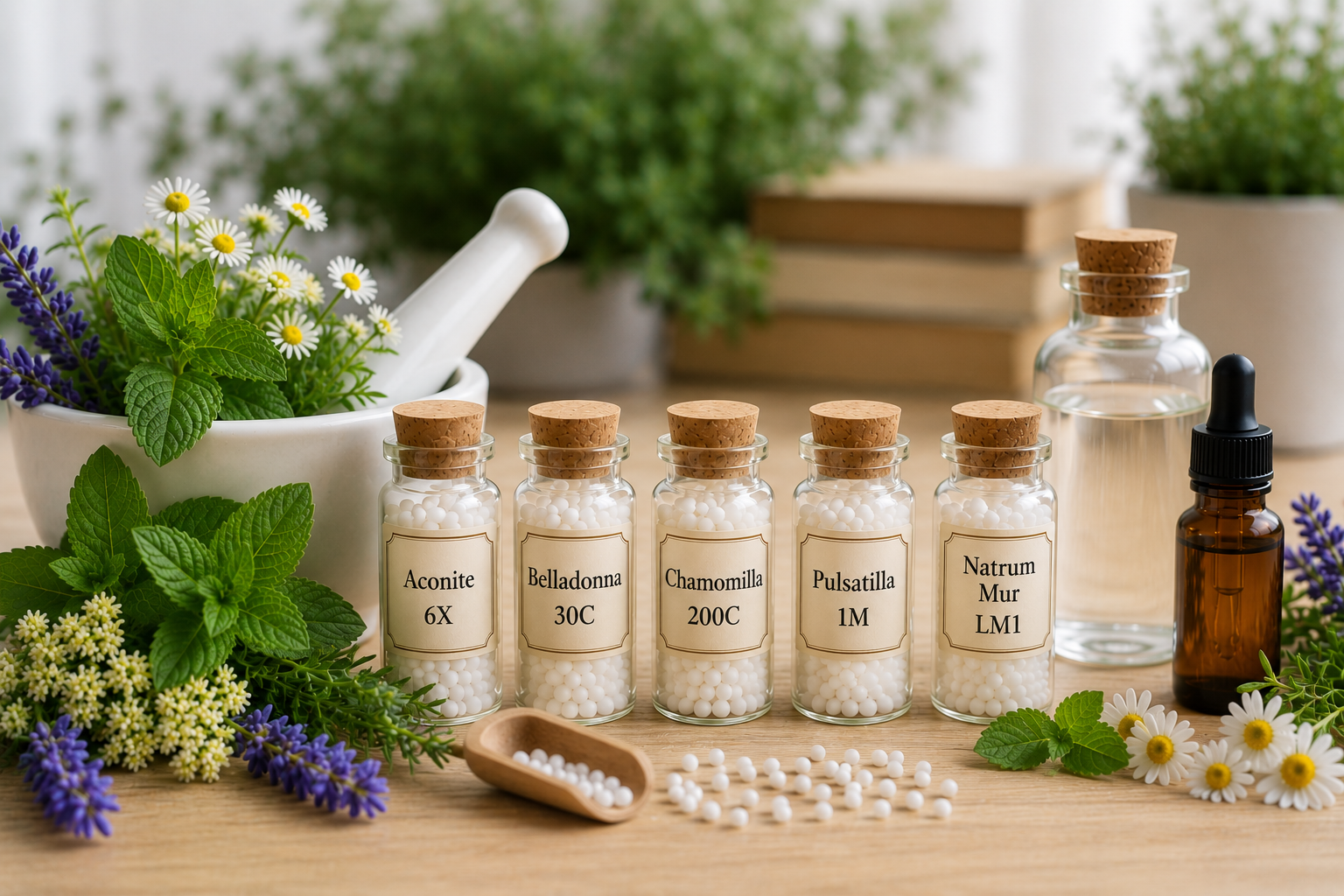
One of the most common questions people ask when beginning homeopathic treatment is: “What do all the numbers and letters mean?” You may have seen remedies labeled as:
- 6X
- 30C
- 200C
- 1M
- LM1
At first glance, homeopathic potencies can seem confusing. Yet understanding the basics can help you feel more confident and informed when using homeopathy.
In classical homeopathy, potency refers to how many times a remedy has been diluted and succussed (vigorously shaken) during preparation. Potency is not simply about “strength” in the conventional sense. In homeopathy, different potencies work at different depths and levels within the person.
What Does “Potency” Mean in Homeopathy?
Homeopathic remedies are prepared through a process called potentization. This involves:
- Diluting a substance in water or alcohol
- Succussing (shaking) it in a precise way
- Repeating the process multiple times
The purpose of potentization is not to create a stronger chemical effect, but to enhance the energetic or dynamic action of the remedy according to homeopathic principles. Different potency scales exist, and each has its own uses.
The Main Homeopathic Potency Scales
Decimal Scale (X or D Potencies)
The decimal scale uses a 1:10 dilution ratio.
- 1 part original substance
- 9 parts diluting medium
This process is repeated for each potency level. Examples:
- 3X
- 6X
- 12X
- 30X
Common Uses of X Potencies
X potencies are often used for:
- Tissue support
- Nutritional-style remedies
- Gentle repeated dosing
- Acute conditions
- Biochemic cell salts
They are generally considered lower potencies and are frequently found in over-the-counter remedies. Examples: Common cell salts often come in 6X or 12X potencies.
Centesimal Scale (C Potencies)
The centesimal scale is the most widely used system in classical homeopathy. It uses a 1:100 dilution ratio.
- 1 part substance
- 99 parts diluting medium
Each step is succussed before the next dilution. Examples include:
- 6C
- 12C
- 30C
- 200C
- 1M
- 10M
- CM
Understanding Common C Potencies
6C
A lower potency often used for:
- Minor acute complaints
- Physical symptoms
- Frequent repetition
30C
One of the most commonly used homeopathic potencies worldwide. Traditionally used for:
- Acute illnesses
- Emotional symptoms
- General household prescribing
- Mild to moderate chronic issues
Many beginner homeopathy kits contain remedies in 30C potency.
200C
A deeper-acting potency often used by experienced practitioners. May be selected for:
- More intense acute illnesses
- Strong emotional states
- Longstanding patterns
- Constitutional prescribing
Because higher potencies can act more deeply, they are often repeated less frequently.
1M
“M” means 1,000 in Roman numerals. 1M is a significantly higher potency and is generally used in constitutional or chronic prescribing by trained homeopaths.
Higher Potencies: 10M, 50M, CM
These are very high potencies used primarily by experienced classical homeopaths in carefully selected cases. They are not necessarily “stronger” in a conventional sense, but they may act more deeply and for longer durations.
LM or Q Potencies
LM potencies (also called Q potencies) were developed later in Samuel Hahnemann’s work. Examples:
- LM1
- LM2
- LM3
These remedies are prepared differently from C potencies and are often used in chronic treatment.
Why Some Homeopaths Prefer LM Potencies
LM potencies are valued because they may allow:
- Gentle daily dosing
- Gradual adjustment
- Reduced aggravations
- Flexible management of chronic conditions
Many classical homeopaths use LM potencies for sensitive individuals or complex chronic cases.
Are Higher Potencies Stronger?
This is where homeopathy differs from conventional medicine. In homeopathy:
- Higher potency does not simply mean “stronger”
- Different potencies act differently
- The best potency depends on the individual, not just the diagnosis
A 30C is not automatically “weaker” than a 1M in every situation. The correct potency depends on factors such as:
- Sensitivity of the person
- Nature of the illness
- Emotional and mental symptoms
- Vitality
- Acute vs chronic condition
- Previous remedy response
Choosing the right potency is part of the art of classical homeopathy.
Why Potency Selection Matters
Two people with the same diagnosis may need:
- Different remedies
- Different potencies
- Different dosing schedules
This is why classical homeopathy focuses on the whole person rather than simply matching remedies to diseases. Potency selection can significantly influence:
- How deeply a remedy acts
- How long the effect lasts
- How often the remedy should be repeated
Can You Take the Wrong Potency?
In many cases, low potencies used occasionally are unlikely to cause major problems. However, repeated use of high potencies without guidance may sometimes lead to unnecessary aggravations or confusion in chronic cases. For this reason, constitutional prescribing is best done with the guidance of an experienced classical homeopath.
The Philosophy Behind Potencies
Homeopathy views illness as more than a purely physical process. Remedies are selected to stimulate the body’s self-healing response on energetic, emotional, mental, and physical levels. Potentization is central to this philosophy.
Although the mechanism remains debated in conventional science, homeopaths over the past two centuries have observed different effects from different potency levels in clinical practice.
Final Thoughts
Homeopathic potencies can seem complicated at first, but the basics become easier once you understand the different scales:
- X = decimal scale
- C = centesimal scale
- LM/Q = fifty-millesimal scale
The most important thing to remember is that potency selection is individualized. In classical homeopathy, the remedy, potency, and repetition schedule are all chosen based on the unique person in front of the practitioner. A carefully selected potency can make a significant difference in how a remedy works.
Looking for Individualized Homeopathic Care?
At Natural Bridges Homeopathy, we provide classical homeopathic care for chronic and acute conditions with an individualized approach tailored to the whole person.
Book a consultation: If you are interested in constitutional homeopathy or want guidance choosing remedies appropriately, you can learn more or schedule a consultation through our website.