
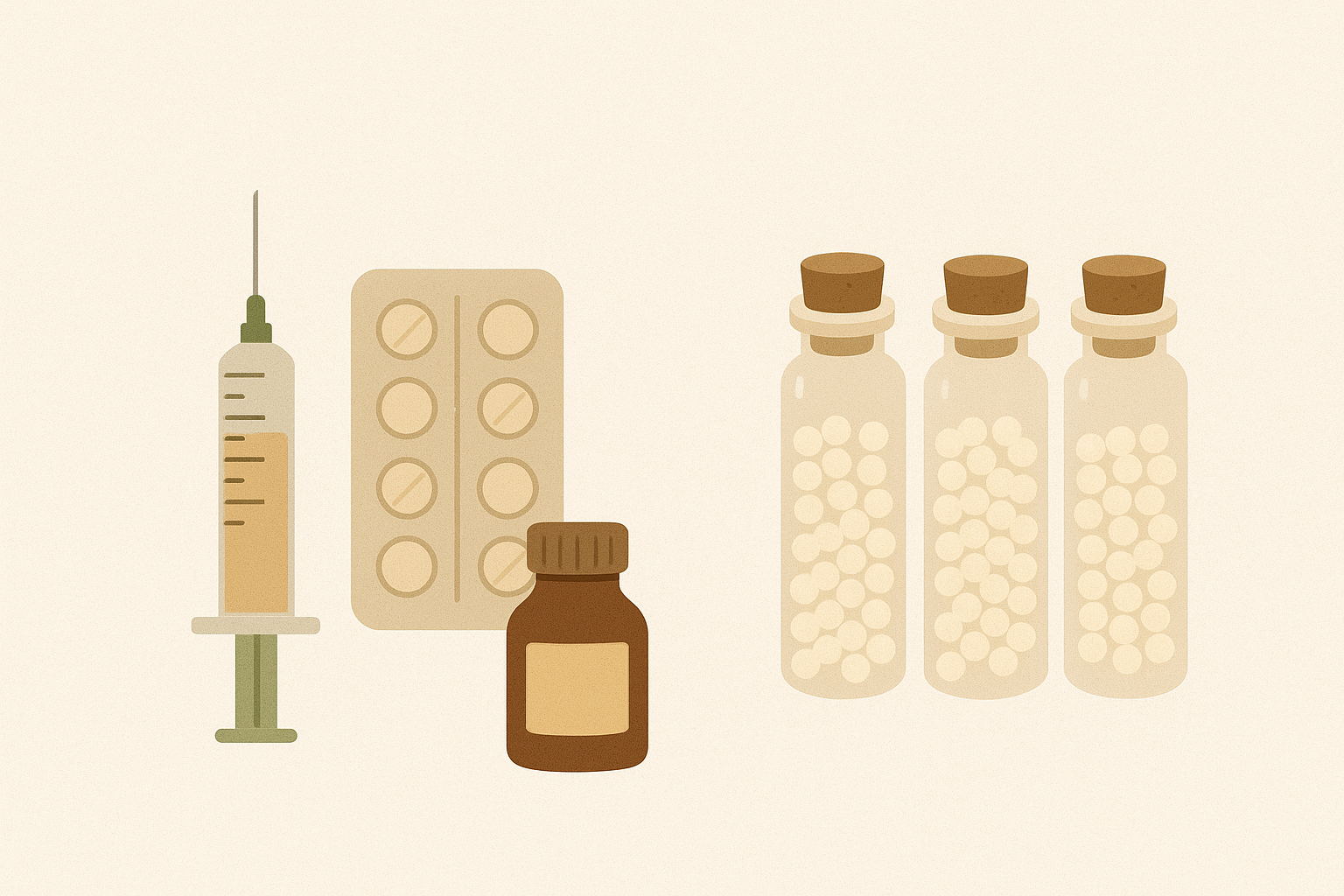
When people first discover homeopathy, one of the most common questions they ask is:
“How is this different from conventional medicine?”
Both systems aim to improve health — but they view the body, symptoms, and healing in very different ways. Understanding these differences can help you choose the approach that feels right for you, your family, and your long-term well-being.
1. Homeopathy Treats the Whole Person — Not Just the Diagnosis
In mainstream medicine, treatment is usually guided by a diagnosis. If ten people walk in with migraines, they’ll likely walk out with similar medications.
Homeopathy works differently.
A homeopath looks at you as a whole person — your physical symptoms, emotional patterns, stress responses, sleep, digestion, triggers, history, and even your personality.
Two people with the same diagnosis may receive completely different remedies because their overall pattern of imbalance is different.
Homeopathy asks:
“Who is the person behind the illness?”
Mainstream medicine asks:
“What disease do we need to treat?”
2. Symptoms Are Clues — Not Problems to Silence
Mainstream medicine often aims to control or suppress symptoms: painkillers for pain, antacids for heartburn, steroids for inflammation.
These tools can be incredibly helpful — especially for acute or emergency situations — but they may not address the deeper reasons symptoms keep returning.
Homeopathy sees symptoms as messages from the body. Instead of shutting them down, it works to understand why they’re happening and select a remedy that gently stimulates the body’s natural healing process.
Think of symptoms as the body’s warning lights. Homeopathy aims to address the cause behind the light — not simply turn it off.
3. Individualized Care vs. Standardized Protocols
Mainstream Medicine
- Uses established protocols and standardized medications
- Prioritizes evidence based on large populations
- Excellent for acute care, infections, and emergencies
Homeopathy
- Tailors every remedy to the individual
- Seeks a precise match between the person’s symptom picture and the remedy
- Particularly effective for chronic, recurring, or emotionally linked issues
Where conventional medicine often says:
“This is the standard treatment for this disease,”
Homeopathy says:
“Let’s find the remedy that matches you.”
4. How Remedies Work vs. How Drugs Work
Conventional drugs act chemically — they force a change in tissues, hormones, or biochemical pathways. This can be lifesaving, but also comes with potential side effects and long-term impacts.
Homeopathic remedies work very differently.
They are highly diluted, potentized substances that carry an energetic or informational imprint. Their role is not to overpower the body, but to gently stimulate its own ability to self-correct.
Because they do not work chemically:
- Remedies are generally non-toxic
- Safe for children, elderly, and sensitive individuals
- Can be used alongside conventional treatments (with proper guidance)
Homeopathy relies on the body’s wisdom.
Mainstream medicine often relies on direct biochemical intervention.
5. Chronic Illness vs. Acute Care
Another key difference is where each approach shines.
Mainstream medicine excels at:
- Emergency and trauma care
- Surgery
- Acute infections needing intervention
- Life-threatening situations
Homeopathy shines in:
- Chronic illnesses
- Stress-related conditions
- Emotional and psychosomatic complaints
- Recurring patterns (migraines, allergies, skin issues, hormonal imbalance)
- Subtle, long-term imbalance that doesn’t show up on lab tests
Many people use both systems together — mainstream for emergencies, and homeopathy for long-term healing and prevention.
6. Time, Listening & the Therapeutic Relationship
One of the most meaningful differences is the experience of the consultation itself.
In mainstream medicine:
Appointments are usually 10–15 minutes, focused on diagnosis, tests, and medication choices.
In homeopathy:
Consultations often last 60–90 minutes.
Your homeopath explores your symptoms at every level — physical, emotional, mental — and listens deeply to your life story, stress patterns, and what makes you uniquely you.
This holistic, slow, and attentive approach is a central part of the healing process.
7. Safety, Side Effects & Long-Term Impact
Conventional treatments can be powerful and essential. They can also have side effects that require monitoring.
Homeopathic remedies, by contrast:
- Are non-toxic
- Do not create drug dependency
- Rarely cause side effects
- Can be safely integrated into long-term wellness plans
This makes homeopathy a gentle companion for lifelong health.
So How Are They Different?
In the simplest terms:
| Homeopathy | Mainstream Medicine |
|---|---|
| Treats the whole person | Treats the diagnosed disease |
| Works with the body’s healing force | Directly alters physiology |
| Individualised remedies | Standardised protocols |
| Gentle and energetic | Biochemical and often strong |
| Best for chronic imbalance | Best for acute/emergency care |
| Long, holistic consultations | Short, focused visits |
Both systems have value. They are not opposites — they are complementary.
A Modern Approach: Integrating the Best of Both Worlds
More people today choose to combine homeopathy with mainstream care. They rely on modern medicine when needed and use homeopathy to:
- heal deeply
- support emotional health
- reduce chronic symptoms
- strengthen resilience
- prevent long-term imbalance
This integrative path brings together the strengths of both systems — something many families find to be the most balanced and empowering way to care for their health.