
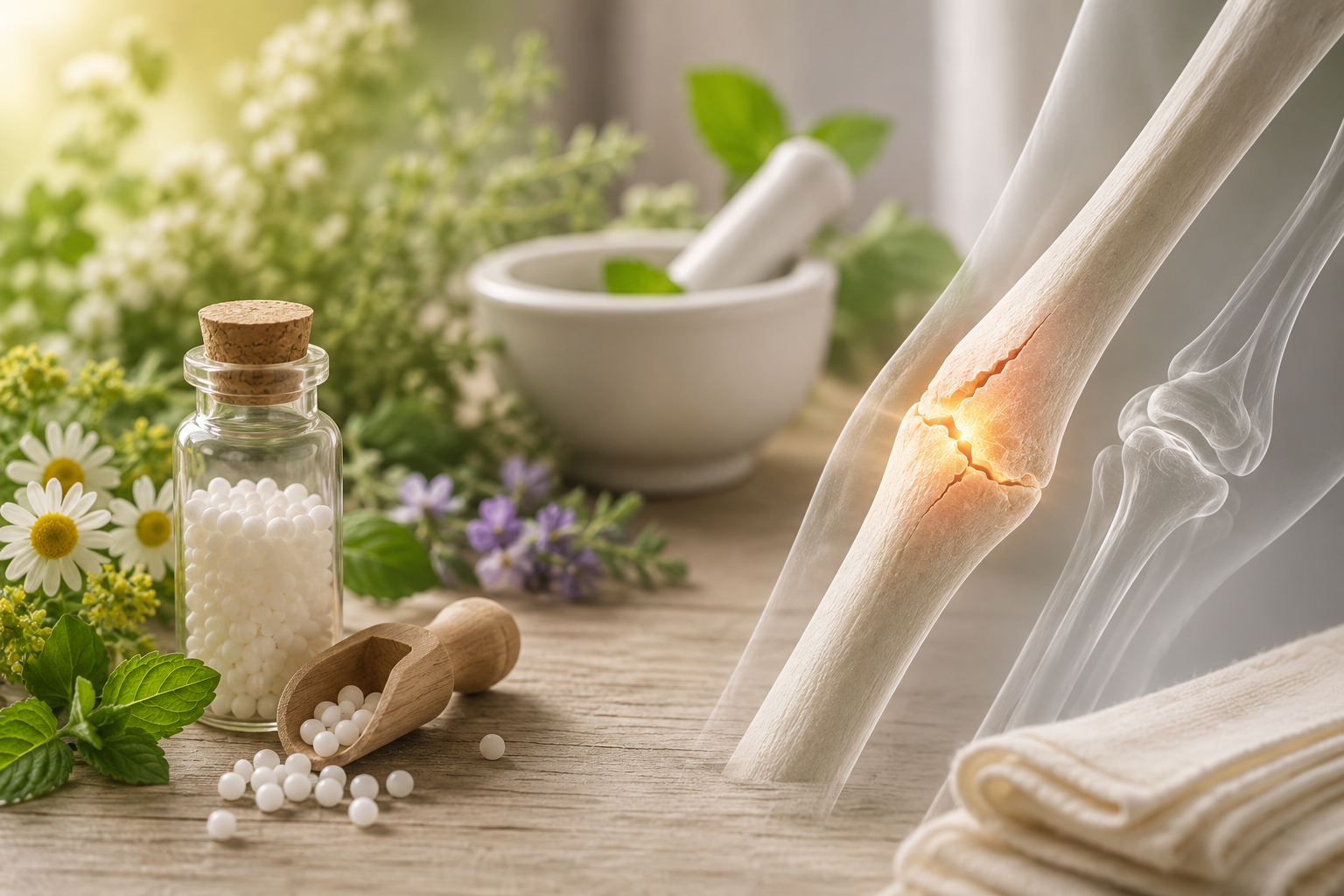
When someone breaks a bone, the question often arises: Can homeopathy help it heal?
The honest answer—one that respects both physiology and clinical experience—is this: homeopathy does not replace the mechanical setting of a bone, but it can meaningfully support the body’s healing process once proper care is in place. Let’s unpack what that really means.
The Nature of Bone Healing
Bone healing is not a passive event. It is an intelligent, highly coordinated biological process involving inflammation, cellular repair, and remodeling. Even in conventional medicine, once the bone is properly aligned and stabilized, the body itself does the real work of knitting it back together.
From a classical homeopathic perspective, this is where our role begins. We do not “force” healing. We stimulate the organism’s inherent capacity to restore order—what Hahnemann referred to as the vital force.
Where Homeopathy Fits In
A fracture requires proper orthopedic management first—this may include imaging, reduction (setting the bone), and immobilization (cast or splint). Without this, no system of medicine—homeopathy included—can ensure correct structural healing. Once that foundation is laid, carefully selected homeopathic remedies may help:
- Support tissue repair
- Reduce pain and inflammation
- Encourage callus formation (early bone knitting)
- Address shock or trauma from the injury
- Potentially shorten recovery time
- Help prevent complications in some cases
But—and this matters—these outcomes depend on individualization, not routine prescribing.
Commonly Considered Remedies (Not One-Size-Fits-All)
In practice, several remedies are frequently associated with injuries and fractures. However, they are not interchangeable, and they are not prescribed simply because “there is a broken bone.”
Arnica montana
Often considered in the immediate aftermath of trauma—especially where there is bruising, soreness, and shock.
Symphytum officinale
Sometimes referred to as “bone knit,” it is traditionally used when there is a clear affinity for bone healing and pain at the fracture site.
Ruta graveolens
More commonly indicated where there is injury to periosteum (the bone covering), ligaments, or tendons.
Calcarea phosphorica
Considered in cases where healing is slow, particularly in individuals with certain constitutional tendencies.
A classical homeopath does not prescribe based on the injury alone, but on the totality of symptoms—including the patient’s general state, response to pain, emotional state, and healing pattern.
A Critical Distinction: Structure vs. Vital Response
This is where many misunderstand homeopathy.
- Orthopedics addresses structure (alignment, stabilization)
- Homeopathy addresses function (how well the organism heals)
Both matter. Neither replaces the other. If a bone is poorly set, even the best remedy will not correct mechanical misalignment. Conversely, even a well-set fracture may heal slowly or with complications if the body’s vitality is compromised.
What Patients Often Notice
In clinical practice, patients using well-prescribed homeopathy alongside conventional care sometimes report:
- Less intense or shorter-lasting pain
- Reduced swelling and bruising
- A smoother recovery experience
- Feeling “more themselves” despite injury
These observations are meaningful—but they are not guarantees, and they should be approached with clinical humility.
Safety First
A fracture is not a condition for self-treatment. Always ensure:
- Proper diagnosis (often via X-ray)
- Professional orthopedic care
- Monitoring for complications (e.g., poor alignment, infection)
Homeopathy should be used as an adjunct under guidance, especially in more serious fractures.
The Deeper Perspective
From a homeopathic standpoint, injury is not just mechanical—it is also a shock to the whole organism. Two people can sustain the same fracture and heal very differently. One recovers quickly; another develops prolonged pain, delayed healing, or systemic fatigue. This is where individualized care becomes essential.
Final Thoughts
So, can homeopathy mend broken bones? No—not in the mechanical sense.
But it can support the living process that mends them. And in many cases, that support can make a meaningful difference in how a person experiences recovery.
A Gentle Invitation
If you or someone you care for is recovering from an injury and you’re curious about a more individualized, supportive approach, I offer consultations that integrate classical homeopathy with a clear understanding of conventional care. Every case is individual—your symptoms, healing response, and overall vitality all matter in selecting the right remedy approach.
Book a consultation: If you’d like personalized guidance, you’re welcome to book a consultation at my clinic. Together, we can look at your recovery in a way that supports not just the bone, but the whole person healing around it.
Healing is not just about fixing structure—it’s about restoring balance.